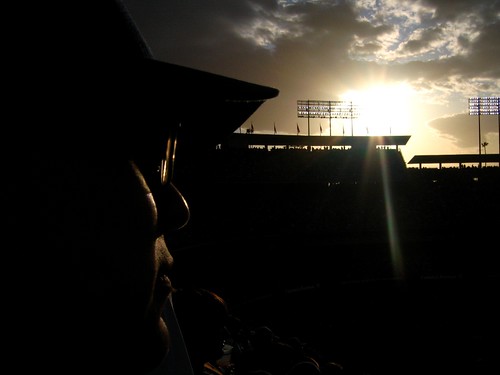
SO we've been talking about how one person's "beautification" or "gentrification" is another's eviction notice and life-altering nightmare. It can scar generations to come.
In light of that uneasy legacy, a few years back, musician, Ry Cooder, turned his attention to the lost L.A. neighborhood we've been talking about, Chavez Ravine.
Instead of re-animating the tangle of streets on a blank page, he tried to sort out a way to make the old neighborhood -- and the rich culture that grew up in it and around it -- bloom again in a series of songs. He went back to the source and found musicians -- bandleader, Don Tosti, Lalo Guerrero (the "father of Chicano Music") and Little Willie G. (of Thee Midniters) -- to not just share remembrances of the time, but to shape and shade the recording lending their voices, instruments and arrangements.
Instead of re-animating the tangle of streets on a blank page, he tried to sort out a way to make the old neighborhood -- and the rich culture that grew up in it and around it -- bloom again in a series of songs. He went back to the source and found musicians -- bandleader, Don Tosti, Lalo Guerrero (the "father of Chicano Music") and Little Willie G. (of Thee Midniters) -- to not just share remembrances of the time, but to shape and shade the recording lending their voices, instruments and arrangements.
The result was an album, Chavez Ravine, that told the story of the now vanished neighborhood -- its neighborhood rituals, its people, its music, its struggles with the city father's and power brokers, the result of eminent domain -- and of course -- hundreds of families and their displacement and, ultimately, the rise of Dodger Stadium.
Below you'll be able to listen to a couple of cuts from the project. They are bookends -- the first sketches the neighborhood as it was "Poor Man's Shangri-La" ; the second is told from the POV of a former-resident recalling where his family's house once stood "Third Base, Dodger Stadium"
This is storytelling, a study of voice. Songs take us places, the best songs do, because they articulate something specific that we can hang on to. Pay close attention to the specific details that gently place you in the moment -- a very specific time and place.
Below you'll be able to listen to a couple of cuts from the project. They are bookends -- the first sketches the neighborhood as it was "Poor Man's Shangri-La" ; the second is told from the POV of a former-resident recalling where his family's house once stood "Third Base, Dodger Stadium"
This is storytelling, a study of voice. Songs take us places, the best songs do, because they articulate something specific that we can hang on to. Pay close attention to the specific details that gently place you in the moment -- a very specific time and place.
-- L.G.