Showing posts with label Jaide Garcia. Show all posts

Friday, May 6, 2011

Dominique Moody: Nomad


THE woman in the picture is the artist in residence in the house across from the Watts Towers. Her name is Dominique Moody and she has been legally blind for the majority of her life. Pictured here is the creation of her life long dream. The idea of the "Nomad" has inspired her to travel California and spread her art. She creates things out of recycled objects found in the environment and plans to do the same with objects she finds on the road.

--J.Garcia

Southeast of West L.A.

I was really excited when I saw this while walking in Hollywood. Just the night before I had seen it for the first time in class among Kevin McCollister's photo's. It was difficult for me to picture him walking around L.A. taking pictures of random things until I was walking around L.A. the very next day taking pictures of random things.


--J.Garcia

Wednesday, April 27, 2011

Jaide Garcia - Genius Loci: "Artistic Spirit"


THIS first picture says so much about the hidden spirit of L.A. because it captures how amazing aspects of the city are underrated. The Watts Towers are a huge landmark being represented on a tiny sign that shares a post with a "Dead End" sign, adding irony to the location. The Charles Mingus Youth Arts Center is another development in the area worthy of more attention. 


I went to South Central to find the hidden spirit of L.A. The community of Watts has so much history and culture that makes it a target for attention. Unfortunately, most of that attention is negative. After the Watts Uprisings in 1965 the neighborhood's reputation has gone from bad to worse. If you google Watts or Compton the first things to pop up are articles about gangs, the historical 'Riots' or NWA. However, in recent years the community has set out to re-establish itself and draw attention to the professional athletes, musicians and artists that it has produced. The Watts Towers have served as a symbol of pride and have spurred many artistic developments in the area. The sad thing is that the towers are mainly known internationally and by those proximally close to the community. I grew up near L.A. and I had never heard about the towers until this year. Many native Angeleno's that I've talked to didn't know what they were either! Yet they are recognized internationally as a great piece of art and visited by foreign tourists all the time.


--The second picture is self-explanatory and reveals the lack of care shown to our city's up-keep.--


A sight like this is definitely common while walking the streets of L.A. As depressing as it is it still represents the spirit of the city because of the consumerism followed by waste that is prevalent here. There is a lack of pride in the presentation of neighborhoods and streets that is evident through the mediocre response of tourists. When people visit L.A. what they see is what they get, but usually not what they expected. It may be embarrassing and yet we all still contribute to it.


--The third and fourth pictures capture the 'street art' that is popularly found in the L.A. area.--


There is real beauty to be found in these pictures. I am the least artistic person in the world so when I see things like this on the side of the road I am amazed before I am irritated. The spirit of this neighborhood in particular is displayed in the art found all over its city. Many graffiti artists have one way to share their voice and this is the only way they know how to be heard. In the same way there are many people who come to L.A. to pursue their form of art and follow their passion, even if it is misunderstood by those around them.

--The fifth and sixth picture are of a house and art center on 107th street in Watts. Many of the houses have unique styles and patterns on them in light of the towers that are directly outside their window. The art building was painted by members of the community over 30 years ago and is now used by their children.--

As disconnected as L.A. may be, there are still areas with a strong sense of community. The multiple areas within L.A. each have their own identity, but it is a collective identity. Areas such as Watts, Glendale, La Mirada, Yorba Linda and many others are segregated by ethnicity. As much as I don't like the segregation, I respect the close environment found in those places. There is so much individuality represented within the region that creates its own distinctive atmospheres and this picture represents one of the strongest cases of community spirit.


Last but not least, this location hidden at the end of 107th street in Watts represents the spirit of cultural diversity found in L.A. Although the neighborhood is predominantly African American and Latino, it once was home to people of German, Italian, Chinese, and Japanese descent as well. It was truly a cultural melting pot that served to bring people together and connect the creative aspects of many backgrounds. This neighborhood was a part of the "California Dream" that attracted many travelers and immigrants in the early 20th century. L.A. may lack many things, but the spirit of diversity will always be prevalent no matter where one finds themselves.


--J.Garcia


Thursday, April 21, 2011

California Squirrels: They're Unforgettable


LOS ANGELES, definitely isn't known for its wildlife. We don't have "deer crossing" signs within the city and the only animals we see while passing through usually have to be scraped off the pavement within four hours. While the majority of animals are domesticated others are just a very long way from home. This absence of animal competition may be what allows the squirrels to thrive in L.A. Leave it to Hollywood to attract the irregular actresses, singers, dancers...... and squirrels. They really do have a couple things in common! They can use their looks to charm people out of being angry with them. They're prone to stage fright. Their eclectic diet's consist of random things. And sometimes, not always, but sometimes everything is all about them (this only pertains to those in the L.A. region, I'm sure it's not like that anywhere else.....).
Walking around LMU's campus I literally have to divert my walking path to avoid stepping on squirrels. Fighting my inner temptation to boot them back into the bushes, I look them straight in the eyes as if to communicate: "this is my turf. Beat it, Esse." I'm sure they get it. From outside my window I catch them looking in spying on me and I can't tell if they wish to be apart of the Hannon 122 family, or if they're plotting something big. I get a little nervous I'm not going to lie.

I used to find them entertaining; running around frantically in zigzag patterns along the sidewalk. To my Hawaiian friends the "sqwur-ell's" served as a brand new species and they couldn't get over how cute and funny they were. Even just last weekend my grandmother was on campus and she suddenly stopped everyone's conversation and directed our attention towards a nearby squirrel with a half eaten piece of pizza in its mouth. She saw an innocent animal with quirky behavior-- I saw a thief!

I may be overreacting to the behavior of these varmints, I'm just tired of having to redirect my steps in order to not inconvenience them. I'm curious, are they like this everywhere else? I've done a bit of traveling and have never noticed the squirrel's in other places. Is that because they act like normal squirrel's and keep to themselves? Being one of the main subjects of wildlife, they're all-about-me characteristics represent the area frightfully well. Maybe my irritation lies with the bigger picture of L.A. but is being manifested through its all-star rodents. In that case, there's further observing to be done. To the sidewalk I go!

--J. Garcia


image: squirrel on barbed wire, via you are here, los angeles photo gallery

Tuesday, April 19, 2011

Misread City -- The Final Meditations

dscf0001.jpg

"I am interested in how the attention of the towers has affected the community and how members feel about their style and size. I want to see how the community feels about them and whether they take pride in the towers or rarely thinks about them at all."
The Watts Towers -- Jaide Garcia


images: watts towers, teikan; glendale, julian bleecker ralph bunche house, south los angeles, kansas sebastian: fashion district, oracio alvarado; watts, laurie avacado via flickr creative commons
~~~~~~~~~~
Glendale Amtrak Station

"As I recently have come to find out, Glendale used to be a city not very much liked by people not living in the city . Come to find out, Glendale used to be very racist and was home to the West Coast Nazi Headquarters. I find that to be completely shocking . . . however, I am sure that there are others who still have that perception of Glendale being [a] racist city. I am curious to find out about the history of the city and how the city started to change after a large number of people (Armenians) began to move to Glendale...I tis interesting that a city that was home to the racists is now a very diverse environment."
Talin Manooki -- the City of Glendale
~~~~~~~~~~~~~~~~~~~~~~~~~~~~~

01 - Ralph J Bunche Home - HCM-159 - NRHP-78000686 (E)

"For my final assignment, I want to speak to a classmate of mine who was born, raised and still lives in 'South Central' Los Angeles. His family's story represents the overall theme of the assignment, as his older brother has eared an doctoral degree from USC while his other brother is in prison. I find it interesting how different the two have turned out and it really suggests the dual atmosphere within the city. One brother fills the cliche that cannot be avoided, while the other has mode more of his circumstances. "
-- South Los Angeles -- Hailey Hannan
~~~~~~~~~~~~~~~~~~~~~~~
Fashion District in Downtown Los Angeles

"I would like to write about the L.A. Fashion District, off Maple and 11th Street, because I think that it can be misinterpreted. I have been coming here for years now and the first time I ever stepped foot there, I was really turned off by the culture and the location of the alley. I [plan] to ask people work the street carts or sell their goods to the public about the area. This will provide the sources for my reporting aspect of the essay. As for the reading and further information, I would like to incorporate the ideals fo gentrification and possibly graffiti into the story."

-- The Fashion District, Downtown -- Chelsea Vogt

~~~~~~~~~~~~~~~~~~~~~~~~


Watts Neighborhood Sign
"My roommate, Sam, grew up in Kansas. Sam moved back to Los Angeles to attend LMU and work in the animation department. She has since received awards for her academic success as a black woman in her field . . . . being her roommate and her friend, I have been invited on a couple of occasions to join her family, lead by Aunt Alice....Alice is a quiet and stern woman whom everybody in the family respects and who has managed to do quite a bit to keep her family in Watts. Most of all the children go to magnet schools. Alice immigrated from Belize and Sam keeps a picture of the shack that Alice grew up in, in her dorm room on her desk to remind her of her family's struggles and her hope to visit their beginnings. I'm thinking a juxtaposition, demonstrating Watts can be an end in a successful story rather than an unfortunate beginning."
-- Watts -- Alex Deutsch

Monday, March 28, 2011

Voice -- The Great Pier Fire


LOST BUT NOT FORGOTTEN


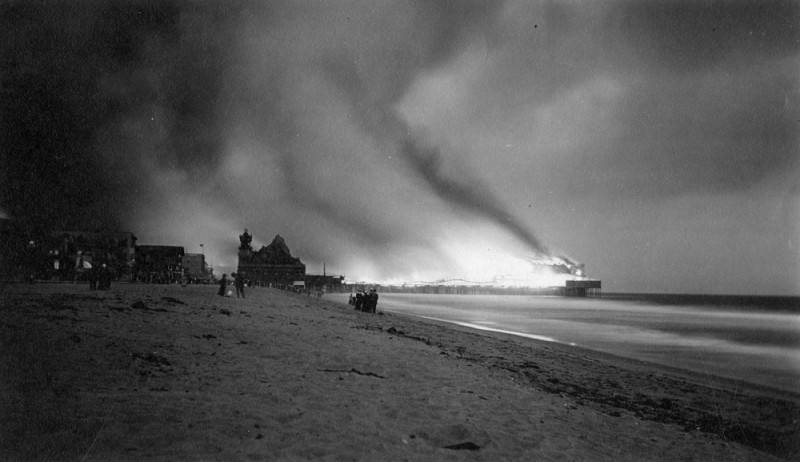
This picture gives me a glimpse into a world that I never knew but somehow miss. It introduces the Pacific Ocean Park to me while at the same time taking it away. It is common to not understand the importance of something until it is gone, and I believe that to be the case here. One day during the second week of its opening the park’s attendance number was greater than Disneyland’s. Families appreciated having to pay only an admission fee and still get to ride the fun ocean themed rides that were available to all ages. Similar to my experience with this photograph, the experience of this center for fun, entertainment, and a home for sea creatures came and then quickly disappeared.

I put myself on the Santa Monica beach where this picture was taken and I can imagine how my five senses would be burning along with the fire. My eyes damp with tears at the sight of the only tangible evidence for so many memories being destroyed. My ears hear the mixture of waves lapping calmly while the sirens frantically roar their way closer and closer. I can smell the wood burned smoke and it smells so good but makes me so sad at the same time. I can taste salt on my tongue from the ocean and its useless freshness; the water surrounds the scene yet does nothing. I feel the wind coldly blowing on my face and I can’t decide whether I have stared long enough and it is time to go, or if I need more time to process my nostalgic thoughts and release them to burn with the flames.

I’m sad that what was once a place of happiness for so many can be forgotten so quickly and there’s nothing to be done about it. The truth is that this fire brought closure to a park already lost. Despite it closing down a few years before, it was no longer serving its intended purpose. A big junkyard playground for the neighborhood kids to graffiti and litter on is what it had become. Fire can physically destroy but not mentally erase, and the memory of this park will forever hold its own importance to those who knew about it.
-- J, Garcia


A PARK IN FLAMES

The park was ablaze.

From miles away, the children, teenagers, and adults who once looked forward to spending their free time at the Pacific Ocean Park now watched their leisure melt like the popsicles sold on the boardwalk on a scorching California day. What caused the fire? Park operators are still unsure and rumors consuming the surrounding neighborhoods, those residents who capture views of the park every day, bounce back and forth between gang related debauchery and a simple mechanical error sparking a small flame that went unnoticed until consuming the majority of the pier.

The park looks beyond repair, as the flames last evening engulfed not only the amusement rides but also the vendor booths, games, and food stands leaving nothing but charred boardwalk, unsafe for anyone to even wander upon. Pacific Ocean Park had long been suffering from cases of bankruptcy. Families who visited the pier left shaking their heads as more and more amusement rides hosted “Closed Until Further Notice” signs. Perhaps the fire came from angry creditors, infuriated with the park’s attendance drop. Assembling and rioting that the “POP” executives were swindling them of their money and rushing the park after hours with matches in their hands and fury in their eyes. Did they not stop to think of the kids who still depended on that park for after school fun? For only 90 cents, kids treated themselves to a day at the park instead of a day on the streets.

Now, the streets are all they have, for Disneyland lies many bus rides away and suddenly rocks and sharp objects have caught their attention rather than mazes and roller coasters. The fire has not only demolished part of California’s history but it has also shattered many young Angelenos past and future memories of the pier.

-- Katie Mollica


PACIFIC OCEAN PARK FIRE

Tonight the lights from Pacific Ocean Park are void of joy and void of excitement; they bring with them a sense terror as we gaze at the jarring site. Sounds of carnival games are replaced by a cracking of wood. There are no couples huddled together for warmth as they watch the faint stars twinkle over the water. There is no laughter and no excitement. From here, the roof of the carousel is little more than a dark silhouette against the flames. The end of the pier is still visible, but the flames look as though the water is fueling them upward as the win pushes inland.


On the beach, officers prevent us from venturing closer, so we dig our into the cold sand - staring. Sirens blare, signaling the arrival of firemen. Thick smoke crawls up my nose the way ants pour out of an ant hill, but I can’t tear my eyes away. An elderly woman near by coughs, muttering about the incompetence of the park owners. She seems certain that teenagers “were up to no good”. I thought that was a nice way to put it; if that’s the case.


Fires seem to ravage nearby land constantly, but not on the Westside. Here, the concern of natural disasters holds little weight. With the exception of a few new high rises, any threats of fires or earthquakes seem distant. Living beside the beach, a stone throw from carnival rides and cinnamon covered churros, threats concern only neighbors and the vagrants passing through. The park burned once before, but not like this. The flames and smoke make any visuals of the rides impossible and even the carousel is gone. With an eerie image of the fire and the water burned into my mind, I walk home, tossing unredeemed tokens in the trash.


-- Sarah Kruberg

SNAP CRACKLE BURN


Help. I’m burning in my own contradiction. I thought technology, our own stuff, would be sufficient to enhance the grasp over nature. The juxtaposition is fitting. My fire, your water. Yin yang we are all dust. Let me burn, let me burn, this world mandates my demise. Construct on the face of adversity and prepare for the downfall. How many times must a toothpick splinter under nature’s footprint? Fall into disrepair to be attempted anew? Are you wholesome enough to withstand the test of ages? Try me.
I burn for the immigrants. Those people seen but not heard. Is there a noise beneath the surface? Would you notice my struggle if it didn’t light the sky with an ashy haze? Or would your saline womb lull you to passivity. I think you thrive on an image heard but not seen. Everyone tells you what to wear, how to act—but that’s not you. You aren’t a sideshow attraction to garner interest in outside lands and novel characters. You are the outside. Stop looking in for a minute and appreciate your position on the verge.

Burn. The wildfire wakeup. Impels my dream state. To burn. Under ancient stars. Around new stars. We are stars. And so we burn.

My smoke distorts what is real. You see wood (from Big Sur) under metal structures (from mines to mind) twisted in shapes of a reality less lived.

My ash covers what is not.

-- Weston Finfer


(photo via wikipedia commons)

Friday, February 18, 2011

Loyal to Lies

A Blue History

I AM a sports fanatic. Although partial to some sports more than others, give me the opportunity to go to any professional game and no matter what sport it is I’ll be there. I admit that my favorite teams range far outside L.A. county's vicinity but I'm still able to appreciate the loyalty of L.A. fans. The intense and competitive atmosphere takes focus away from racial bias or hatred and challenges that energy toward the game. Notoriously known for its die-hard fans, the Dodgers stadium fills with people of all backgrounds coming together and cheering on their team. Encouraging as it may be, this sense of camaraderie came with a cost.

Before the massive stadium was built, there was a community of around 300 families living in that area previously known as Chavez Ravine. Due to industrial purposes they were forced to move out of their homes under the impression that they would soon be able to return after reconstruction. However, the proposed project fell through and a decision was made to build the Dodger’s stadium instead. Devastated, the people of Chavez Ravine would never be able to resume the peaceful lives they once lived and were reminded daily of the cause of their displacement. A former inhabitant of Chavez Ravine said that going to a game was like “dancing on a grave,” and she could not stand it.

It’s interesting that out of the thousands of Dodgers fans that go to every single game or buy season tickets, very few of them know the history of the stadium's construction and the lives it affected. The sad thing is that if more people knew it still probably wouldn’t make a difference. There's nothing that can be done about it now so it’s not something anybody wants on their conscience. However, I choose to make a silent statement for the families of Chavez Ravine that were forced out of their homes without any place to go. I love sports, and I love going to all competitive games, but I won't step foot again in the Dodgers stadium out of respect for the families whose stories are untold. From now on I will not have a conversation about the Dodgers without sharing the “random fact” that has changed my attitude toward the importance of all sporting events. It may bring people together, which I recognize and appreciate, but a steady community was destroyed in order to create a temporary community that only comes together a couple hours a week. I have to ask myself, where’s the loyalty in that?

---- J.Garcia

caption: "A Blue History"
photo credit: Amanda Yepiz via Flickr creative commons

Monday, February 14, 2011

How Far Will It Go?

THE more I learn about the history of L.A., the more I am inclined to not want to be from here. The rapid growth in population was due to an idea that never existed. People chased after a land and a lifestyle that they thought could take away their problems and worries. Competing with San Francisco for size and popularity, the two rail lines that made it happen were the Southern Pacific in 1876 and the Santa Fe in 1886.


In the ten years between 1880 and 1890 the population grew from 11,000 to 50,000. Outgrowing San Francisco was no longer a concern due to the room that southern California had for expansion.After the 1930s, Los Angeles had a population of 2.2 million and was the second largest city in the United States, competing with New York for being the most culturally diverse. I am proud of Los Angeles for its multi-ethnic background, but I am ashamed at the behavior of the “Anglos” towards the other races in the process of settling. The old southern California idea of Manifest Destiny disappoints me and I wish I could have been around to tell Horace Bell and the Los Angeles Rangers exactly what I think of them and their vigilante behavior.

It’s understandable that the people of Los Angeles would use the sunshine as propaganda to promote the region, but labeling it names such as the New Italy, New Spain, and New Athens is taking it a little too far. Not to mention the terms New Eden and Holy Land-- as if the people here lived in complete peace and harmony with one another. I agree with Carey McWilliams when he said that the overwhelming migration to L.A. may have been the largest but it was “the least heroic.”

The continuation of expansion due to the aviation industry, the Pacific Electric rail lines, and the Auto Club spread the outer boundaries of L.A. north to San Fernando, south to the harbor, and west to the coast. With new land came new divisions that are still seen today. It’s interesting to see the breakdown of territory in the mid 1900s and how much things still haven't changed. The Westside of Wilshire and Sunset was home to the Anglo’s, while the East L.A., Boyle Heights area was dominantly Mexican-American. South Central, commonly known as Watt’s, was inhabited by the African American community and I suppose it has changed a bit today because now it includes a community of Asians and Latinos.

Angeleno’s dared to label Los Angeles as the "American Dream Capital, keeper of our national fantasies.” Is that a joke? Sunshine and a couple movie sets don’t make up for the lack of cultural unity and intense racism that was rampant in all areas of L.A. What makes it even worse is that there are still traces of that same racism and segregation today. People are so busy “chasing the dream,” that they couldn’t and still don’t see Pandora’s jar lying open and empty. Is it safe to say that hope has finally escaped? Have we dug ourselves in a hole so deep that it’s going to take more than 4,083 miles of track to reach down and pull us out?

-- J. Garcia