Showing posts with label voice. Show all posts

Monday, April 25, 2011

Hummus and Tamales

A QUICK  note to alert you all to Prof. Ruben Martinez' piece that ran in the Los Angeles Times' Op-Ed section on Sunday.  It ran as he read it in our preview.

BTW, One of the local bloggers, Jesus Sanchez on his Eastsider L.A. blog, also seized on the Hummus and Tamales metaphor Martinez used as a way to explore the cultures coming together in his gentrifying Mt. Washington neighborhood.

(image via umich.edu)

Friday, April 1, 2011

Erasure -- Chavez Ravine

SO we've been talking about how one person's "beautification" or "gentrification" is another's eviction notice and life-altering nightmare. It can scar generations to come.

In light of that uneasy legacy, a few years back, musician, Ry Cooder, turned his attention to the lost L.A. neighborhood we've been talking about, Chavez Ravine.

Instead of re-animating the tangle of streets on a blank page, he tried to sort out a way to make the old neighborhood -- and the rich culture that grew up in it and around it -- bloom again in a series of songs. He went back to the source and found musicians -- bandleader, Don Tosti, Lalo Guerrero (the "father of Chicano Music") and Little Willie G. (of Thee Midniters) -- to not just share remembrances of the time, but to shape and shade the recording lending their voices, instruments and arrangements.

The result was an album, Chavez Ravine, that told the story of the now vanished neighborhood -- its neighborhood rituals, its people, its music, its struggles with the city father's and power brokers, the result of eminent domain -- and of course -- hundreds of families and their displacement and, ultimately, the rise of Dodger Stadium.

Below you'll be able to listen to a couple of cuts from the project. They are bookends -- the first sketches the neighborhood as it was "Poor Man's Shangri-La" ; the second is told from the POV of a former-resident recalling where his family's house once stood "Third Base, Dodger Stadium"

This is storytelling, a study of voice. Songs take us places, the best songs do, because they articulate something specific that we can hang on to. Pay close attention to the specific details that gently place you in the moment -- a very specific time and place.


-- L.G.

Monday, March 28, 2011

Voice -- The Road to Hollywoodland


HOLLYWOODLAND

The idea of “Hollywoodland” has always seemed to evoke fond sentiments and nostalgia of Los Angeles’s previous life. The name itself seems to say it all: Hollywoodland. Not just a destination on a map, but a ‘land’, creating a sort of mythology behind it. But the Hollywood we know today seems to differ from the Hollywoodland that once was. The famous letters remain resting on a hill, yet the ‘land’ no longer exists. Even though this four minor letters have disappeared, more developments have taken its place. Rather than the depiction of an isolated Hollywoodland hills at the end of a dirt road, today we find the Hollywood sign to be surrounded by shops, tourists and vehicles. This all takes away from the simplicity of where this sign once was viewed from.

The Hollywoodland sign in the picture represents the idealized Hollywood, perhaps what was even planned for. It could be a destination for many yet still maintain a professional amount of simplicity. It appears to be a desirable place where you can leisurely walk and take the surroundings of a city that is still in the cusp of development. Where only two vintage cars took residence, you would now found vehicles of all sizes lined up for rows. Where patches of grass once were you may find a coffee shop or tourist kiosk. The Hollywoodland that was once a “city on a hill” for many has now become engulfed by itself. Yes, the final four letters were lost to an accident, but it seems to be symbolic in a sense – four letters down, how many to go until Hollywood is indistinguishable from how it was first intended? Many may continue to view Hollywood as it stands today, four letters short, without really acknowledging the way the city once was.


TINSEL TOWN
The iconic image of the “Hollywoodland” sign represents both a sophistication that never existed and an attitude that still permeates the area today. Originally an advertising gimmick for the expensive new track of houses on the nearby Hollywood hills, the sign has become such an important part of L.A.’s identity that public donations were gathered in the mid-2000s when it was announced that the letters needed either a facelift or removal since they had deteriorated to the point of danger. “Hollywood,” as the sign now reads, stands out a brilliant white against the green hills that are its backdrop.
Both the word and the sign itself have an image that is hard to define. To most non-California natives, Hollywood is a magical city in Los Angeles where starlets both work and play. They imagine that the sign announces the border of this city where movies are made and the elite are privileged enough to live. The reality is very different. Hollywood is not a real city – it is as fake as the sets of the movies filmed on lots nearby. “Hollywoodland,” the housing district the sign originally announced, has made way for newer and flashier properties in the true L.A. fashion that even the grandest is not grand enough. Though the majority of films and TV shows credited to Hollywood are actually filmed throughout the vast Los Angeles County, the sign will stand for the ability to sell an image, and idea begun by the L.A. boosters in the late 19th century and perfected today by countless talent agents.
-- Andi Edgett

Voice -- The Four-Level


FOUR LEVELS INTO MY HEART


The four level interchange immediately annoys me.

It irritates me that I have to look at it via aerial view, because I’ve sat in it first handedly. My grandma and her friends refer to it as the “four letter” interchange, but this is what Los Angeles traffic does to some people. It drives elderly women to use four letter words to describe their roadways. When I think about what I’ve learned so far in this course, about how freeways created pockets of living spaces and how they allowed us to only come into contact with those we wanted, I begin to see that the 101 and 110 coming to a head showcases this beautifully. This is a beauty that can only be described with concrete and polluted inhalation. Literally people coming from all directions, north, south, east, and west, are forces to sit in traffic next to one another and absorb each other’s company, even if it is from the comfort of your own Jetta. And what happens when we allow these people to “mingle” on the grid-locked freeways? They brandish weapons over lane-changes and scream inexcusable phrases that force the blood in their carotid arteries to nearly burst. We must really love our neighbors.

It is so easy for me to quickly be harsh on my fellow Angelenos. I describe them as brutish savages that are willing to fight for a stop in the carpool lane. But I must acknowledge that I am not above them. Allow us to remember my initial reaction to the picture: annoyance and irritation. Maybe I should work on my own anger issues, but until then I will continue to put on my blinker a mile and a half before I actually need to get over in order to ensure I make my exit. Hand gestures and honked horns aside, the sweeping lanes of infrastructure could be incredibly calming to the right person. I guess I’m just not that right person today

-- Hailey Hannan

FOUR-LEVEL INTERCHANGE

In the center of the urban jungle that is downtown LA, the 101 and the 110 freeways flow into each other like colliding concrete rivers. Horns and sirens make up the music of the four-level interchange as millions of commuters chug their way through the clutter of the crowded lanes. BMWs and Mercedes mix with old VW buses and big rigs, showing the true diversity of the city. In a city that is so spread out, this is the one place all Angelenos are forced to come together. Though everyone is heading off to their own corner of the city, for these few hours in the morning and afternoon, everyone from all walks of life gathers on these cement pathways.


For some, the highways provide escape—a passageway to another alcove of this amazingly diverse city. Hop on the 110 to travel downtown to the ultra-urban LA Live center. Take the Marina freeway down into Santa Monica or Venice and stroll along the boardwalk. Cruise down the 101 to take a tour of the film studios in Hollywood. No matter where you are in the city, entertainment is just a car ride away.


For most however, the highway system is a nuisance—an eternal headache in an otherwise ideal metropolis. Hours upon hours are spent with a foot on the break, banging on the steering wheel, fuming in an unmovable pod of frustration. Because of the densely packed roadways, appointments are missed, plans are canceled, and people are left waiting. “Traffic” is not an inconvenience, but rather a fact of like in LA.

-- Megan McMurtrey


PICTURE

Every level represents different ideas, mentalities, life styles and values. A four-level freeway doesn’t need an explanation because it speaks so loudly on it’s own. Yet once zoomed in, all those cars on the freeway represent different people who are after different things. Driving east a mother going to work, driving west a student rushing to get to class on time, driving north an explorer wondering where the freeway leads, driving south a human being living life. What’s interesting is not the difference in their agenda, but how they all use the same freeway to take them where they want to go. They are all different people but have found a way to “share” the freeway, share LA.

The four-level freeway in Downtown Los Angeles represents how residents of LA are able to work together, yet be after completely different things. The freeway is a visual of how LA is separated, as each level represents a different way, different lifestyle, but they are all LA residents. They all live in LA and although most may complain about the traffic going on, they don’t leave LA. The freeway represents the chaotic elements of the city, since there are four levels of freeways. Four. That symbolizes how different LA really is; no one part is similar to the other as none of the four levels go the same direction.

-- Talin Manooki


THE "FOUR LEVEL" -- DOWNTOWN

Don’t be fooled by the first look of this grey maze of freeways. It is not just another lifeless picture of boring infrastructure, but an intricate design or maze, if you will, for not only cars but people to get to where they want. A place where desires and needs are put in one direction, but can take many twists and turns. It comes in the form of low bridges, high ramps, and different sized underpasses, and stands as really the most picturesque of all the freeways of California. Of course the Pacific Coast Highway has the ocean view and beach breeze, but it is no comparison for the “four level”, which is full of magnificent columns that could hold up the world if it had to.

The maze that is this freeway, could almost act as a metaphor for life. One where there are many opportunities and directions. Most likely, like the cluster of traffic also creates, takes a long time to finally arrive at that original goal. But it is attainable, and not only attainable but one can view so much more while on the road to that goal. They can see other traditions, sample other culture’s foods, ask for directions from a native, or simply get lost and possibly go a route you never knew existed.

The piles of cement take on a 3-D look that pops off the page, inviting anyone to take on the adventure and join the hundreds of other people that are probably on one of the freeways at this very moment. There are plenty of buildings to pop into and people who are waiting to tell their story and possibly help in achieving yours. Are you coming?

-- Jessica Fernandez

(photo via wikipedia commons)

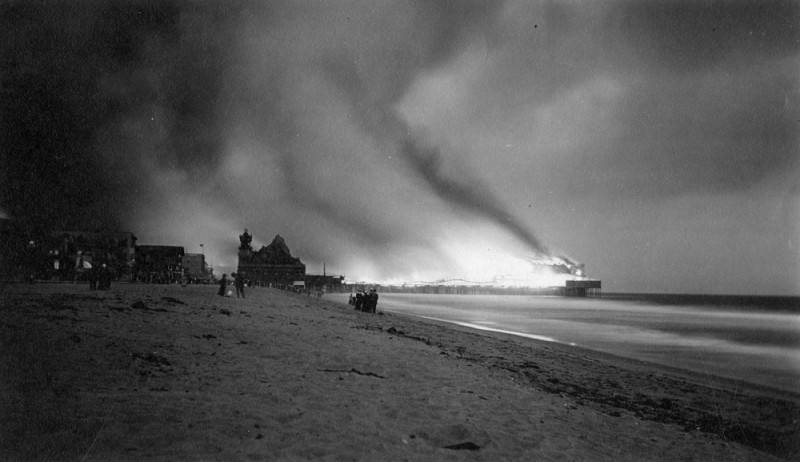
Voice -- The Great Pier Fire


LOST BUT NOT FORGOTTEN


This picture gives me a glimpse into a world that I never knew but somehow miss. It introduces the Pacific Ocean Park to me while at the same time taking it away. It is common to not understand the importance of something until it is gone, and I believe that to be the case here. One day during the second week of its opening the park’s attendance number was greater than Disneyland’s. Families appreciated having to pay only an admission fee and still get to ride the fun ocean themed rides that were available to all ages. Similar to my experience with this photograph, the experience of this center for fun, entertainment, and a home for sea creatures came and then quickly disappeared.

I put myself on the Santa Monica beach where this picture was taken and I can imagine how my five senses would be burning along with the fire. My eyes damp with tears at the sight of the only tangible evidence for so many memories being destroyed. My ears hear the mixture of waves lapping calmly while the sirens frantically roar their way closer and closer. I can smell the wood burned smoke and it smells so good but makes me so sad at the same time. I can taste salt on my tongue from the ocean and its useless freshness; the water surrounds the scene yet does nothing. I feel the wind coldly blowing on my face and I can’t decide whether I have stared long enough and it is time to go, or if I need more time to process my nostalgic thoughts and release them to burn with the flames.

I’m sad that what was once a place of happiness for so many can be forgotten so quickly and there’s nothing to be done about it. The truth is that this fire brought closure to a park already lost. Despite it closing down a few years before, it was no longer serving its intended purpose. A big junkyard playground for the neighborhood kids to graffiti and litter on is what it had become. Fire can physically destroy but not mentally erase, and the memory of this park will forever hold its own importance to those who knew about it.
-- J, Garcia


A PARK IN FLAMES

The park was ablaze.

From miles away, the children, teenagers, and adults who once looked forward to spending their free time at the Pacific Ocean Park now watched their leisure melt like the popsicles sold on the boardwalk on a scorching California day. What caused the fire? Park operators are still unsure and rumors consuming the surrounding neighborhoods, those residents who capture views of the park every day, bounce back and forth between gang related debauchery and a simple mechanical error sparking a small flame that went unnoticed until consuming the majority of the pier.

The park looks beyond repair, as the flames last evening engulfed not only the amusement rides but also the vendor booths, games, and food stands leaving nothing but charred boardwalk, unsafe for anyone to even wander upon. Pacific Ocean Park had long been suffering from cases of bankruptcy. Families who visited the pier left shaking their heads as more and more amusement rides hosted “Closed Until Further Notice” signs. Perhaps the fire came from angry creditors, infuriated with the park’s attendance drop. Assembling and rioting that the “POP” executives were swindling them of their money and rushing the park after hours with matches in their hands and fury in their eyes. Did they not stop to think of the kids who still depended on that park for after school fun? For only 90 cents, kids treated themselves to a day at the park instead of a day on the streets.

Now, the streets are all they have, for Disneyland lies many bus rides away and suddenly rocks and sharp objects have caught their attention rather than mazes and roller coasters. The fire has not only demolished part of California’s history but it has also shattered many young Angelenos past and future memories of the pier.

-- Katie Mollica


PACIFIC OCEAN PARK FIRE

Tonight the lights from Pacific Ocean Park are void of joy and void of excitement; they bring with them a sense terror as we gaze at the jarring site. Sounds of carnival games are replaced by a cracking of wood. There are no couples huddled together for warmth as they watch the faint stars twinkle over the water. There is no laughter and no excitement. From here, the roof of the carousel is little more than a dark silhouette against the flames. The end of the pier is still visible, but the flames look as though the water is fueling them upward as the win pushes inland.


On the beach, officers prevent us from venturing closer, so we dig our into the cold sand - staring. Sirens blare, signaling the arrival of firemen. Thick smoke crawls up my nose the way ants pour out of an ant hill, but I can’t tear my eyes away. An elderly woman near by coughs, muttering about the incompetence of the park owners. She seems certain that teenagers “were up to no good”. I thought that was a nice way to put it; if that’s the case.


Fires seem to ravage nearby land constantly, but not on the Westside. Here, the concern of natural disasters holds little weight. With the exception of a few new high rises, any threats of fires or earthquakes seem distant. Living beside the beach, a stone throw from carnival rides and cinnamon covered churros, threats concern only neighbors and the vagrants passing through. The park burned once before, but not like this. The flames and smoke make any visuals of the rides impossible and even the carousel is gone. With an eerie image of the fire and the water burned into my mind, I walk home, tossing unredeemed tokens in the trash.


-- Sarah Kruberg

SNAP CRACKLE BURN


Help. I’m burning in my own contradiction. I thought technology, our own stuff, would be sufficient to enhance the grasp over nature. The juxtaposition is fitting. My fire, your water. Yin yang we are all dust. Let me burn, let me burn, this world mandates my demise. Construct on the face of adversity and prepare for the downfall. How many times must a toothpick splinter under nature’s footprint? Fall into disrepair to be attempted anew? Are you wholesome enough to withstand the test of ages? Try me.
I burn for the immigrants. Those people seen but not heard. Is there a noise beneath the surface? Would you notice my struggle if it didn’t light the sky with an ashy haze? Or would your saline womb lull you to passivity. I think you thrive on an image heard but not seen. Everyone tells you what to wear, how to act—but that’s not you. You aren’t a sideshow attraction to garner interest in outside lands and novel characters. You are the outside. Stop looking in for a minute and appreciate your position on the verge.

Burn. The wildfire wakeup. Impels my dream state. To burn. Under ancient stars. Around new stars. We are stars. And so we burn.

My smoke distorts what is real. You see wood (from Big Sur) under metal structures (from mines to mind) twisted in shapes of a reality less lived.

My ash covers what is not.

-- Weston Finfer


(photo via wikipedia commons)

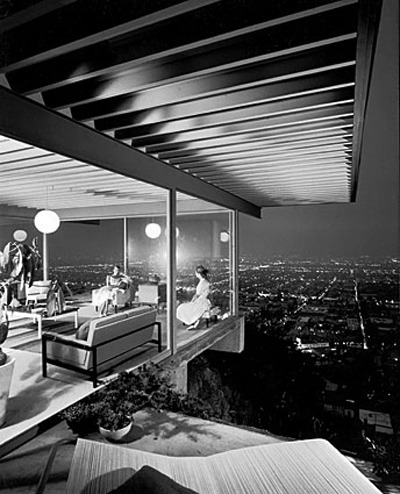
Voice -- Case Study House #22


THE CASE STUDY HOUSE

As these women discuss their eventful day of cooking and cleaning, the city of Los Angeles shines below them. The bright lights inside and out reflect upon the glass windows that surround them. There is no shielding themselves from the outside world, and the inhabitants of LA cannot hide themselves either. Built on a hill overlooking the vast and occupied land, there is a chance that most people would say this house has quite a view. On the other hand, I would not. My audience should be the people I am speaking with, not the city as a whole. There is no privacy, no escape.


If I were to guess using these women, the furniture, and the lack of lights in the city, I would say this picture was taken in the late 1950’s to early 1960’s. By the looks of these women, their attire, their posture and their stance, each points to this picture being taken decades before this one. The woman “relaxing” in the chair looks older, wearing a dress fit for a homemaker and her hair out of her face. The woman sitting against the window looks younger, more obedient. Her legs are tied together like that of a proper queen.

Trends tend to make a full loop from one generation to the next. The contemporary furniture that is shown in this picture proves this very point. What was fashionable then can be seen in family rooms around the nation now. And it’s not because they were hand-me-downs from their grandparents; they bought these brand new and well overpriced. In this picture, the furniture is neatly placed in a clean living room that can be seen by thousands of uninvited guests.


Although it may seem like a lot of lights, I feel that if this picture was taken recently, the city would be giving off an even more intense amount of light. Throughout the decades, Los Angeles has been developed and it will grow even more. At this point, I bet they couldn’t imagine the city getting any bigger, having more people, but it seems as if this city will never hit full capacity.

The camera is perched upon some sort of balcony of the side of the house. I would enjoy not only learning about this house, but also seeing pictures from different views so I could get a sense of the house and figure out the mystery that is the floor beneath the camera. Since all of these points come merely due to my own logical deduction of the photo, I wouldn’t be completely surprised if the majority of my speculations were wrong.

-- Jackie DiBiase


CASE STUDY HOUSE

Looking off into the horizon, clouds, snow-capped mountains, luminescent waves, and lustrous lights can all be seen by the naked eye. The walls, erected by sheet glass allow for this luxury and incredible view. Perched atop a steep hill in the Los Angeles area, the Case-Study house lives on in its 50th year of existence. Built after the Second World War, the house was modeled after the ideology of modernism and the modern residential blueprint. The house itself emulates the persona of Los Angeles at the particular moment in time as well as today’s day and age. Being one of many similar homes constructed for the sole purpose of providing cheap living for the modern American, the Case Study house (in particular number 22), has been photographed, filmed, and toured throughout the ages.

This idea of a translucent structure gazing across the landscape of LA reflects the concept of LA being this powerful and majestic city; however, like the houses themselves, this perception can be shattered with the slightest movement in any direction. Of course, being nestled atop a perilous knoll overseeing the fast paced lanes of the freeways and even possibly the sailboats floating across the sea, this house seems ideal to any real estate connoisseur or affluent family seeking a potential investment. But, to their dismay or ignorance, the house itself cannot provide refuge for any living being. Because, simply put, the house was not built for living but rather for show. Just like the great city, the house represents a picture-perfect scene, much like a movie set or magazine spread.

The family whom the house belongs to have been quoted saying that almost every weekend, the house was used for the sole purpose of tours, photographs, and possible sets for upcoming films. The furniture within the house was all for show and at the end of the day was returned to the designer store, leaving the family with the pre-existing used and furniture not acceptable to show in “real” life. The portrayal of the Case Study houses illustrates the beautiful Los Angeles only in a theoretical sense. Yes, to the tourist the city might be as glorious as the view from the Case Study house, but what lies beneath the foothills and adjacent from the effervescent ocean is the real Los Angeles. The ruined streets and outdated buildings all encompass the notorious city.

From what meets the eye, the glimpse of the Case Study house demonstrates the modernistic approach of building this spectacular structure with the most impalpable tools and materials. As its 50th year of existence approaches, many wonder how the glass walls, concrete floor, and lifted perimeters have survived throughout the decades. To be quite frank, the only reason the house has lasted to the 21st Century is due to the renovation made in order to keep the edifice standing. The fragile building continues to live on with the times, becoming stronger and stronger with each tour and photograph taken.

-- Chelsea Vogt

(case study house #22, credit: julius schulman via 26.media.tumblr.com)

Friday, March 11, 2011

"We Tell Stories" -- Joan Didion

PUBLISHED IN 1970, Joan Didion's, The White Album, is a scrapbook of the political/pop culture landscape of California of the late 60s and 70s. California, and Los Angeles in particular, was lucky to have such an eye turned on the length of its expanse. Deeply reported and even more deeply felt, Didion is able to convey not just political climate, social disarray and personal upheaval but the very texture of the era's tensions, fears, confusion and sense of possibility. As a journalist and essayist, Didion set not just a tone but presented a different template. She was a model for many aspiring reporters and writers who wanted to dig deeper and peer behind perception. Her stories had more than resonance they left an afterimage.

As we turn the corner and begin to contemplate your final pieces -- writing the Los Angeles you see into being, we'll be looking at different writers -- journalists, essayists -- who have left indelible impressions about their Los Angeles. As you think about putting together your reported observations, think about creative ways to weave the facts with observations. Details, very simply set down, are often key in writing prose that draws you in with its careful rhythms.

Here is a sample from The White Album in which Didion recollects the night that the Manson Family murders were set in motion:

"We put 'Lay Lady Lay' on the record player, and 'Suzanne.' We went down to Melrose Avenue to see the Flying Burritos. There was a jasmine vine grown over the verandah of the big house on Franklin Avenue, and in the evenings the smell of jasmine came in through all the open doors and windows. I made bouillabaisse for people who did not eat meat. I imagined that my own life was simple and sweet, and sometimes it was, but there were odd things going around town. There were rumors. There were stories. Everything was unmentionable but nothing was unimaginable. This mystical flirtation with the idea of 'sin' -- this sense that it was possible to go 'too far,' and that many people were doing it -- was very much with us in Los Angeles in 1968 and 1969. A demented and seductive vortical tension was building in the community. The jitters were setting in. I recall a time when the dogs barked every night and the moon was always full. On August 9, 1969, I was sitting in the shallow end of my sister-in-law's swimming pool in Beverly Hills when she received a telephone call from a friend who had just heard about the murders at Sharon Tate Polanski's house on Cielo Drive. The phone rang many times during the next hour. These early reports were garbled and contradictory. One caller would say hoods, the next would say chains. There were twenty dead, no twelve, ten, eighteen. Black masses were imagined, band bad trips blamed. I remember all of the day's misinformation very clearly, and I also remember this, and wish I did not: I remember that no one was surprised."

-- L.G.


photo credit: academy of achievement
(repost)

Wednesday, March 9, 2011

A Question of Voice

I HAVE been thinking about the rich and varied pieces that you all brought in as examples of admired voices; the voices that continue to play in your heads.

Often when I'm just beginning to work on a piece -- particularly if I'm delving into something I know will be difficult to navigate, something long, complex or most likely will be controversial -- one of the first things I want to establish is tone. I realize that pause, is part of my process of centering myself to find my "voice" and consequently, the appropriate tone of the story. I often do this by first grabbing for writers I love and admire whose voices convey both authority and lyricism. Mine?: James Baldwin, Leonard Michaels, Joan Didion, Albert Camus -- for starters. There is something about the way the words move on the page that put me in a what I call my "writers trance" -- when I can hear myself, my voice.

I've been reading a book called The Writer's Voice, by essayist and journalist,A. Alvarez that is a brief meditation on "voice" and how it differs from style. I thought I'd share a piece of what I'm reading here.

"By comparing writing and psychoanalysis, I'm implying that finding your own voice as a writer is in some ways like the tricky business of becoming an adult. For a writer, it's also a basic instinct like a bird marking its territory, though not straightforward or so musical. So how do you do it? First, you do what all young people do: you try on different personalities for size and you fall in love. Young writers, in fact, are a peculiarly promiscuous lot . . . . First the writer's voice dazzles you and you read everything you can lay your hands on. If that doesn't cure you, the sickness goes critical and you become obsessed with the beloved's whole take on life: what he did, where he went, even the kind of people he slept with. You don't want to be like him, you want to be him. In retrospect, infatuation is as embarrassing as promiscuity, but for the writer it is a necessary part of the weary process of growing up."


My question to you, class: Who are the writers that you've fallen "in love with," the voices you've found yourselves mimicking in your own writing as you've worked to find your voice? To find the right "mood" for your piece? Do you still do it? How does it help you get started? Leave comments below.

L.G.